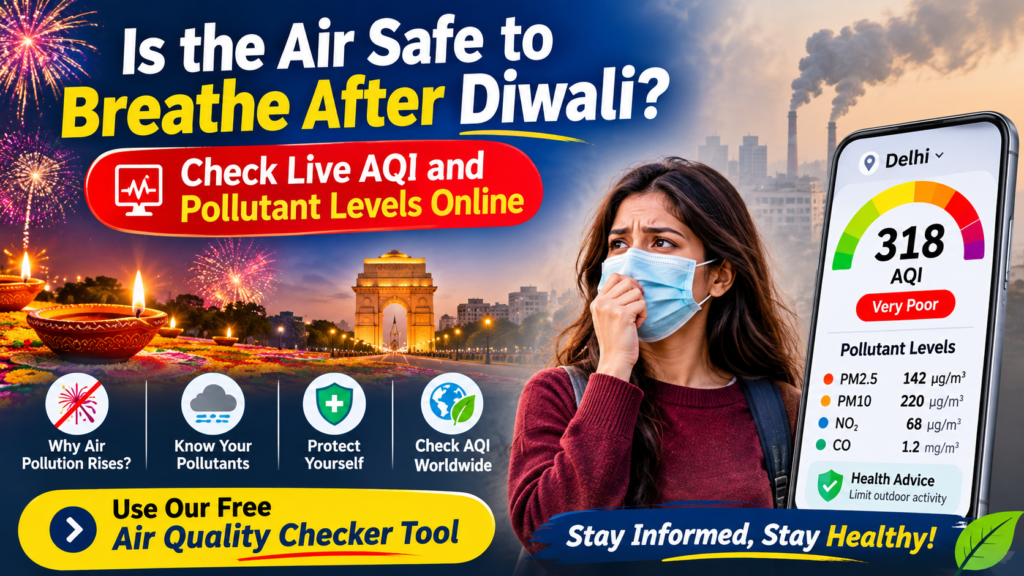
The festival of lights, Diwali, brings happiness, celebrations, fireworks, and togetherness. However, after the celebrations come to an end, many cities across India experience a significant increase in air pollution, often resulting in dense smog and poor air quality.
If you have stepped outside and experienced eye irritation, coughing, or breathing discomfort, it may be time to check the air quality in your area.
Understanding the Air Quality Index (AQI) and monitoring harmful pollutants such as PM2.5 and PM10 can help you make informed decisions about outdoor activities and protect your family’s health.
In this guide, you’ll learn why air pollution increases after Diwali, what different pollutants mean, and how to check live AQI and pollutant levels online for your city using a free air quality checker.
Why Does Air Quality Become Poor After Diwali?
The increase in air pollution after Diwali is influenced by several environmental and seasonal factors.
Here are the main reasons:
- Firecrackers and Fireworks: Burning firecrackers releases particulate matter, smoke, and various gases into the atmosphere, contributing to short-term air pollution.
- Weather Conditions: Cooler temperatures, low wind speeds, and atmospheric conditions can prevent pollutants from dispersing, allowing them to accumulate near the ground.
- Stubble Burning: Agricultural residue burning in parts of northern India can add significant amounts of smoke and particulate matter to the atmosphere during the post-Diwali period.
- Vehicular and Industrial Emissions: Regular emissions from vehicles, industries, and construction activities further contribute to existing pollution levels.
When these factors combine, cities such as Delhi, Gurugram, Noida, and other urban areas can experience unhealthy air quality.
Understanding Air Pollutants: What’s Hiding in the Smog?
When checking air quality online, you may come across several pollutant measurements. Understanding these values helps you interpret the air quality report more effectively.
Here are some of the major air pollutants:
1. PM2.5 (Fine Particulate Matter)
PM2.5 refers to tiny airborne particles with a diameter of 2.5 micrometres or smaller. These particles can travel deep into the lungs and may enter the bloodstream, potentially causing serious health problems with prolonged exposure.
2. PM10 (Coarse Particulate Matter)
PM10 consists of airborne particles measuring 10 micrometres or smaller. These particles can enter the respiratory system and cause irritation, particularly among people with existing respiratory conditions.
3. Carbon Monoxide (CO)
Carbon monoxide is a colourless, odourless gas produced by incomplete combustion of fuels. High concentrations can interfere with the body’s ability to transport oxygen.
4. Nitrogen Dioxide (NO2)
Nitrogen dioxide is mainly released through fuel combustion, including vehicle and industrial emissions. Exposure can irritate the respiratory system and worsen existing breathing conditions.
5. Ozone (O3)
Ground-level ozone is an air pollutant formed through chemical reactions involving sunlight, nitrogen oxides, and volatile organic compounds. It can cause breathing discomfort and respiratory irritation.
6. Sulphur Dioxide (SO2)
Sulphur dioxide is primarily released through burning fossil fuels and certain industrial activities. It can irritate the respiratory system and contribute to the formation of fine particulate pollution.
Check Your City’s Live AQI and Pollutant Levels Online
Instead of guessing whether the air is safe for your morning walk, outdoor exercise, or daily activities, check the latest available air quality information for your location.
Use our free online Air Quality Checker to monitor AQI and pollutant levels.
👉 Check Live Air Quality & AQI for Your City
The free VedantKit Air Quality Checker helps you explore air quality information by entering your city name.
Using available atmospheric monitoring data, you can check:
- European AQI and US AQI: View air quality measurements using two different AQI systems.
- PM2.5 and PM10 Levels: Understand the concentration of fine and coarse particulate matter.
- CO and NO2 Levels: Monitor important gaseous air pollutants.
- Ozone and Sulphur Dioxide: Explore additional pollutant measurements.
- Health Recommendations: Understand suggested precautions based on the reported air quality.
Whether you live in Delhi, Mumbai, Bengaluru, Chennai, or another supported city, use the tool to explore available air quality information before planning outdoor activities.
How to Check Live AQI Online Using VedantKit
Checking your city’s air quality is simple.
Follow these steps:
- Visit the VedantKit Air Quality Checker.
- Enter your city name in the search field.
- Select the appropriate city from the available results.
- View the available AQI readings and pollutant measurements.
- Review the health recommendations and take appropriate precautions.
Tip: AQI readings can change throughout the day. Check the latest available readings rather than relying on an old screenshot or report.
Practical Tips to Protect Yourself and Your Family
Monitoring AQI is important, but taking precautions during periods of high pollution is equally essential.
Here are some practical ways to reduce your exposure to polluted air:
- Limit Outdoor Activities: Avoid strenuous outdoor exercise when AQI levels are high. Check local air quality before going outside.
- Wear a Proper Protective Mask: If outdoor exposure is unavoidable during heavy pollution, use a well-fitted N95 respirator.
- Keep Indoor Air Clean: Close windows and doors when outdoor pollution levels are high. Consider using an appropriately sized air purifier if available.
- Avoid Indoor Smoke: Avoid smoking, burning incense, and other activities that can increase indoor particulate pollution.
- Follow Health Advice: Children, older adults, pregnant women, and people with respiratory or heart conditions should take additional precautions during poor air quality conditions.
If you experience persistent breathing difficulties, chest pain, or other concerning symptoms, seek medical advice.
Frequently Asked Questions (FAQs)
1. What is a good AQI level?
AQI categories depend on the measurement system being used.
For example, under the US AQI scale:
- 0–50: Good
- 51–100: Moderate
- 101–150: Unhealthy for Sensitive Groups
- 151–200: Unhealthy
- 201–300: Very Unhealthy
- 301–500: Hazardous
India’s CPCB AQI scale uses different categories, including Good (0–50), Satisfactory (51–100), Moderate (101–200), Poor (201–300), Very Poor (301–400), and Severe (401–500).
Always check which AQI scale is being displayed before interpreting a reading.
2. Why does air pollution increase after Diwali?
Firecracker emissions, seasonal stubble burning, vehicular pollution, and unfavourable weather conditions can combine to increase particulate matter and other pollutants after Diwali.
3. How often is live AQI data updated?
Air quality monitoring services provide updates at different intervals. The refresh frequency depends on the underlying data provider and monitoring station. Check the latest available timestamp when using an online AQI checker.
4. Can I check AQI for cities outside India?
Yes, you can search for supported cities worldwide using the VedantKit Air Quality Checker. Available readings depend on the coverage of the underlying air quality data sources.
5. Which is more harmful: PM2.5 or PM10?
Both pollutants can affect respiratory health. PM2.5 is particularly concerning because its smaller particles can penetrate deeper into the lungs and may enter the bloodstream.
6. Is it safe to go outside when AQI is very poor?
When AQI reaches very poor or hazardous levels, outdoor exposure should be reduced as much as possible. Avoid strenuous activities outdoors and follow health recommendations for your AQI measurement system.
Final Thoughts: Stay Informed About the Air You Breathe
Diwali celebrations should bring happiness, not health concerns. However, monitoring air pollution becomes especially important when seasonal conditions and firecracker emissions contribute to poor air quality.
Don’t rely on guesswork when it comes to the air you breathe.
Use the free VedantKit Live Air Quality Checker to explore your city’s AQI, monitor pollutant levels, and make more informed decisions about your daily outdoor activities.
Stay informed, protect your family, and share this free tool with friends and relatives so they can stay aware of their local air quality too.